10 Creatvie Homeschool Music Ideas to Enrich Your Days
*This post may contain affiliate links. As an Amazon Associate I earn from qualifying purchases.*
Coming up with homeschool music ideas when you’re not musical yourself can seem really overwhelming.
Music has a unique way of engaging kids and making lessons more enjoyable.
Whether it’s singing, playing instruments, or creating movement to rhythms, incorporating music into your homeschool can enhance learning and provide a refreshing change of pace.
I’m here to help you see how to easily add music study into your homeschool even if you’re not proficient in it yourself.
10 Homeschool Music Ideas That Are Easy to Implement
Here are some creative ideas to bring music into your homeschool routine.
Why Music Matters in Homeschooling
- Boosts Memory: Songs and rhythms can help kids memorize facts and concepts more easily.
- Encourages Creativity: Music inspires imaginative thinking and self-expression.
- Improves Mood: Adding music to your day can make learning more enjoyable and reduce stress.
- Enhances Focus: Active engagement with music helps kids stay focused and motivated.
I’ll also add that it is great to use to break up lessons that are more brain-intensive. Doing some music study is like taking a break without actually taking a break.
Homeschool Music Ideas

#1 Sing Educational Songs
Turn challenging concepts into catchy songs. Sing multiplication tables, grammar rules, or historical events to familiar tunes. Platforms like YouTube and Spotify offer educational songs for every subject.
We use music for Scripture memory as well. It works really well! In fact, I can still recall many, many verses that I learned as a child that were put to music.
#2 Learn About Composers and Music History
Dedicate time to studying great composers and their works. Pair listening sessions with lessons about their lives and the historical context of their music.
You can easily put this together yourself, but there are also some great enrichment curriculums out there that have done all the work for you. Some that we’ve used are: Simply Charlotte Mason, A Gentle Feast, and Gentle + Classical Press.
#3 Play Instruments Together

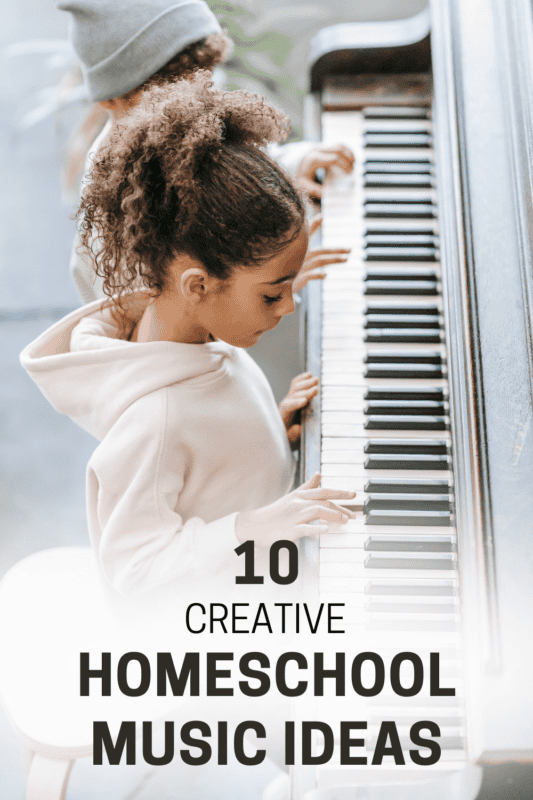
Introduce your kids to instruments like the keyboard, guitar, or recorder. Even if you’re not musically inclined, beginner-friendly online tutorials can help.
We use Hoffman Academy for piano. They also have a free version you can try, which is great!
For online music lessons for littles, Clap for Classics is a wonderful resource.
#4 Create Your Own Instruments
Craft simple instruments using household items. For example:
- Shakers from rice-filled containers.
- Drums from empty cans.
- Harmonicas from craft sticks and rubber bands.
This hands-on activity combines music with STEM learning as kids explore sound and vibration.
You can easily find tutorials to do these activities on both Youtube and Pinterest.
#5 Incorporate Movement and Dance

Use music to encourage physical activity and movement. Teach kids dances from different cultures, or create simple routines to go along with lessons.
There are online dance classes available that are easy to look into, but you can also just do a study on different music and dances both locally and around the world.
#6 Write and Record Songs
Encourage your kids to write their own lyrics about what they’re learning. Use apps like GarageBand or simple recording tools to turn their creations into recorded songs.
This is not just an exercise in the study of music, but also poetry!
#7 Explore World Music
Introduce your kids to music from different cultures. Explore instruments, rhythms, and songs from around the world to teach geography and cultural appreciation.
You could easily make this into a history unit study and make your way all around the world.
#8 Music-Themed Games
Make music learning fun with games:
- “Name That Tune” to identify classical pieces.
- Musical chairs with trivia questions.
- Rhythm matching using clapping or drumming.
#9 Host a Family Music Night

End your homeschool week with a family music night. Take turns sharing favorite songs, performing pieces, or creating a family band.
When we were kids, we would come up with an entire show for my parents. We still all laugh about our antics to this day. It was so much fun!
#10 Use Music for Transitions and Breaks
Play music during transitions between lessons or use it as a signal for specific activities. Upbeat tunes can energize the morning, while calming melodies help with focus during quiet work times.
I have found this to be particularly helpful in the late afternoon hours when everyone is feeling a bit worn out.
I would also add that it’s fantastic to listen to music in the car. This is a great way to expose your children to some of the great composers of days gone by.
Final Thoughts
Incorporating music into your homeschool does not have to be complicated.
From singing songs to crafting instruments, the possibilities are endless. The key is to do it little and often.
Over time, you’ll find that your children gain a lot of knowledge even if you’re not spending hours studying the subject.
If you find that they have a particular musical interest, then you can focus on that some more!