20 Engaging Pre-Reading Activities for Preschoolers
*This post may contain affiliate links. As an Amazon Associate I earn from qualifying purchases.*
We often think of children starting school by learning how to read. The truth is that there are many pre-reading activities that really need to be a precursor to actually reading.
We’re going to talk through the importance of pre-reading activities and how to practically implement them in a way that is both fun and engaging.
As a homeschooling mom of three kids, I’ve walked this road several times now. Retrospect really helps in being able to filter out what works and what doesn’t.
These activities will be helpful even if you have absolutely no background knowledge on the topic of teaching a child how to read.

Why Pre-Reading Activities Matter
When it comes to teaching children how to read, earlier is not necessarily better. It’s all well and good trying to get a head start, but the simple fact is that a child has to be developmentally ready.
However, that doesn’t mean that you have to just step back and do nothing. There are plenty of skills that can be taught before you even begin to teach reading.
The same can be said for handwriting. Many kids aren’t developmentally ready to do handwriting practice at age 5, but that doesn’t mean they can’t do other things to strengthen their little hands in preparation for writing.
Pre-reading activities matter because they give children building blocks that will help to create a strong literacy foundation.
Such activities can make the process of learning to read easier because children have already mastered certain skills.
The best part about it is that these activities don’t have to be formal or difficult. In fact, many of them are things that you will naturally do with your child throughout the day.
Setting the Stage for Pre-Reading Success

As homeschoolers, we have the benefit of being able to create the kind of learning environment we want for our children.
We are the teachers and our homes are our classrooms.
We can decorate and organize, but the truth is that the environment we create is about so much more than the kind of posters we have on the walls.
When thinking about setting up your child for pre-reading success, consider the atmosphere of your home. What is it that you put value in?
In our home, books are consumed daily. We have them on display all over the house and they are easily accessible.
Talking openly and positively about reading and all that it offers is something that we’ve done with our children from the time they were babies.
Create a home and atmosphere that values books so that your child already has a love for them before any formal reading training even begins.
20 Engaging Pre-Reading Activities

Can I let you in on a secret? I didn’t even think about teaching my first child their letters or numbers until around age 4.5.
It just never occurred to me to have to do any of that. Honestly, much of that likely had to do with the fact that I also had a 3-year-old and baby that I was raising.
But, let me also tell you that it really didn’t make a difference because he was learning all the while.
He didn’t need formal sit-down lessons in order to learn. He picked up so much throughout our daily living that when I did actually sit down to do school lessons with him, I was surprised by how much he already knew.
All that to say, you can teach your preschooler without even having to purchase a workbook. Of course, there’s nothing wrong with workbooks. I personally have quite a nerdy love for them. However, my point is that learning and play are not mutually exclusive.
In fact, I would go so far as to say that they are practically impossible to separate when it comes to children.
Many of the activities listed below are things you will already naturally be doing with your preschooler. Perhaps they will just allow you to be a little more intentional.
Regardless, they’re offered as a way to give you confidence and ideas about how to use pre-reading activities to teach your child.
Phonemic Awareness Activities

Being able to hear and identify phonemic sounds is a huge step towards being able to read. It is an essential skill that needs to be mastered. There are some really simple activities that you can do to encourage this.
Children need to be able to identify single sounds before they can really begin to read. You’ll notice in many early learning curriculums that there’s a lot of emphasis on the child being able to identify beginning sounds.
Once they’ve mastered that they’re encouraged to identify ending sounds.
Don’t be discouraged if your child cannot do this! Preschool is all about consistency and exposure. Your child will get it one day.
#1 Put Emphasis on Phonemic Sounds When Reading to Your Child
A very simple way to be intentional about pre-reading activities is to simply focus on what you’re already doing.
Chances are if you’re reading this, then you already read to your child regularly. A great way to help them work on phonetic awareness is simply to emphasize phonemic sounds as you’re reading to your child.
As time goes on, they will pick up on it and be able to point out the phonemic sounds to you.
#2 Use Picture Flashcards to Teach Phonemic Awareness
If you have some picture flashcards at home you can easily use them to work on phonemic awareness.
Simply hold them up and ask your child what the picture is. Then ask what sound is at the beginning of that word.
It’s very normal for children not to be able to figure it out at first. Over time, they’ll pick it up.
You can also do this same activity using books with pictures of animals or something similar.
#3 Point Out Words
Words are everywhere around us! Make it a habit to point out signs and names of things to your child while also pointing out the sound at the beginning of those words.
You could also have an alphabet chart up on the wall and point out the sound of the letters regularly.
#4 Teach the Letters of the Alphabet
Teaching the alphabet and the letter sounds takes time. Do not be disheartened if it doesn’t feel as though your child is retaining any of the information. It will happen!
There are loads of activities for teaching the alphabet and the letter sounds as well as a formal curriculum.
One great resource we’ve loved is the Leap Frog Letter Factory show. My youngest child learned her letter sounds so quickly by watching it regularly.
If you’re not comfortable with screen time for your child, then don’t despair! There are lots of activities that you can do with them to teach them their letter sounds. Letter knowledge comes with time. All of a sudden one day you’ll find that your child has mastered them all and it seemed like it happened overnight!
#5 Play “I Spy”
One game that I often play with my preschoolers is I Spy. However, instead of saying, “I spy something starting with k”, I would say, “I spy something that starts with the sound “k-k-k”.
This is a game you can play practically anywhere and is also awesome for when you might be waiting for an appointment or something like that.
#6 Letter Hunt
There are many ways you can set up this activity. You could hide flashcards around the room, create a scavenger hunt outside, or build your own sensory bin.
In my experience, children love treasure hunts and engage really well with this activity.
My tip would be to refer to the letter sound rather than the letter name until they’ve really mastered the letter sounds.
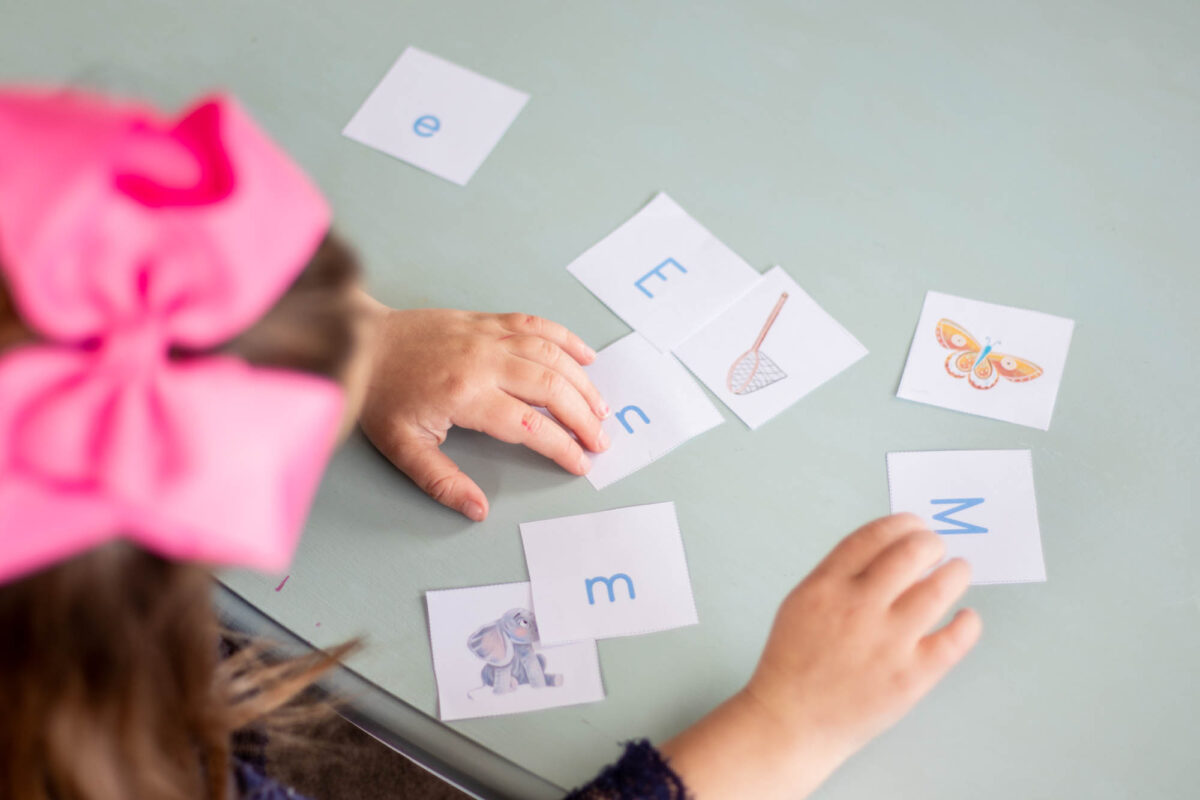
#7 Find the Baby
This is a game I made up for my youngest child when she was learning her letters.
It’s essentially just teaching your preschooler how to identify uppercase and lowercase letters.
I would tell her that the mommy letters (uppercase) had lost their babies (lowercase) and needed her help to find them.
We typically just used flashcards to do this and I’d spread them out on the floor.
It’s super simple and easy to set up.
Vocabulary Building Activities

How do you expand your child’s vocabulary? Honestly, it’s not nearly as difficult as one might think. Here are some easy activities to work on this pre-reading skill.
#8 Read to Them
One of the best ways to expose children to a vast vocabulary is simply to read to them. It’s not rocket science and it’s not even difficult.
Just sit down, snuggle with your child, and read through books.
They will be exposed to a plethora of words which will expand their vocabulary.
A great way to do this well is to read both vintage classics as well as modern-day titles. Obviously, over time our language changes, and therefore children can be exposed to a more expanded vocabulary if you give them a broad range of books to read from.
#9 Label Items
We can’t even really begin to count how many items we have in our homes. There are a lot. So, take advantage of that by labeling them. This is a wonderful way to increase your child’s vocabulary.
Simply point things out as you go and they will very quickly catch on.
#10 Don’t Dumb Down Your Vocabulary
Honestly, this isn’t really an activity per se as much as it is a habit. Don’t dumb down your vocabulary when you speak to your child. Obviously, there are times when we have to explain things to our children differently from how we would explain them to an adult, but we don’t have to dumb things down.
Children are so much more capable of comprehension than we often give them credit. What’s more is that by using age-appropriate vocabulary with them, they learn words in context.
This also rings true for the books we read our children. Every now and then it’s a good idea to read a piece of literature that’s a little above their level. It helps to stretch things and is one of my favorite pre-reading exercises.
#11 Read Poetry Regularly

Poetry is beneficial for a variety of reasons. Not least of which is the exposure to rhyming. Being able to identify rhyming words is a really important precursor to reading.
Poetry also increases vocabulary and encourages creativity.
#12 Play a Rhyming Game
You can formally do this activity or just include it at points during your day. Sometimes I’ll say to my preschooler, “Hey, there’s a cat! What word rhymes with cat?”.
She then answers with whatever she comes up with and we go from there. It’s amazing how far we can take it and how much fun it is for her.
Comprehension Skills Activities
Listening skills are an important part of pre-reading ability. This is something that can be strengthened in your child over time.
#13 Ask for Oral Narration During Stories
Little ones may not have much of an attention span but that doesn’t mean they don’t have any at all.
While I may wait until the end of a chapter to ask my older children for an oral narration, I wouldn’t do the same with my preschooler.
Instead, I would get her to relay back to me what has happened in the story so far after just a page or two of reading.
I don’t necessarily ask questions, but simply ask her to tell me what the story is about. It’s more open-ended and helps children to engage more.
Sometimes I will ask simple questions to prompt my child a little, but I really want to hear what they got from the story.
#14 Get Your Preschooler to Draw a Narration
Another form of narration that is fantastic for preschoolers is simply to have them draw. Give them a piece of paper and ask them to draw what the story is about.
I always love hearing the explanations about what they’ve drawn.
#15 Allow Your Child to Play
Just the other day I was sitting down having a cup of tea and listening to my children play together.
My two youngest children who are 4 and 6 were playing a seemingly very dramatic game which included them being caught up in the air. My 4-year-old declared “We’re going through the wall of the hurricane right now!”.
It made me smile because we had just been learning about hurricanes the week prior. The way we learned about it was by reading a Magic School Bus book on the subject.
I didn’t even know that she was actively listening when I was reading as it was primarily aimed at her older siblings.
Very often, children solidify the information that they are fed through play. It becomes far more real to them and they almost seem to be sorting it all out in their minds.
Playing and learning go hand in hand. Teach your preschooler pre-reading activities and then let them play!
#16 Play “Make a Story”
All three of my children love this game and it’s a wonderful way to encourage comprehension.
I’ll start off a storyline and then have them add to it. It requires them to be good at listening to what I’ve said and then use their imagination and creativity to add to it. Sometimes it’s just a short story and other times it goes on for a long time!
It’s a great game that can be played with all ages!
How to Encourage Pre-Reading Skills
While many pre-reading skills will come on their own over time, there are activities that you can do to encourage them.
#17 Implement Book Time
It is wonderful to snuggle up with your child and read books together but it’s also great for them to do it independently.
Of course, a preschooler likely isn’t going to be actually reading, but they can enjoy books regardless.
Have a regular time of day when your preschooler can look through books on their own. This helps them to learn how to page through books and understand how they work.
Not only that, but they’ll learn to love them too.
I have found my children many a time reading to themselves before they could actually read. They would just make up a story as they flipped through the pages.
#18 Create a Routine
Children thrive on routine. The consistency and predictability help them to feel secure. I strongly recommend creating a routine in which there is regular exposure to books and reading. It should be a normal part of their day that they come to expect.
That way, when it’s time to begin formal reading lessons, they already have that time in their day and they’re used to it.
I would also have their favorite books available to them and easily accessible. My child has a favorite picture book that she goes through on her own every single day.
#19 Go to the Library
Libraries are amazing! Frequent your library often and let your child explore what is available.
I definitely still filter out books that I’d prefer us not to bring home, but I do let my children go through the kids section and find things that they are really interested in.
Even preschoolers love to do this and it will encourage their love of books.
#20 Sensory Play
Finally, a great pre-reading activity is sensory play. While their little minds may not quite be ready to read and their little hand not quite ready to write, sensory play helps build a foundation for both of those things.
There are loads of alphabet sensory play ideas available online that are usually very cheap or even free.
Playdough is one of our favourites to this day and it’s very easy to make at home.
How to Keep Things Fun
Often times homeschool moms are disuaded from doing any formal learning with preschoolers because so many children have been pushed before they are ready.
I like to take a bit of a different approach.
We don’t have to sit down and do worksheets with preschoolers in order for them to learn (although, nothing about worksheets is inherently wrong). We can, however, still be intentionally teaching them while keeping things light and engaging.
Incorporate game sand activities into daily life. Most of the ideas I listed are things that I’ve just naturally done with my children. We didn’t necessarily sit down at a designated time and work through them.
Get into the habit of seeing learning opportunities in your every day and then be intentional about working with your child.
Pre-reading activities are very simple. They are also easy to keep fun.
What’s so important is to keep realistic expectations. Pre-reading activities are about exposure. You can’t hurry a child into mastery. Their brains have to do the work that you simply cannot do for them.
Keep those expectations in check and it will stay fun.
Recommended Homeschool Preschool Curriculum

While you do not need a homeschool curriculum to teach pre-reading activities, there are many homeschool moms who appreciate having everything laid out for them and a plan of sorts. Having a lesson plan for me keeps me accountable. I like having a pre-reading strategy so that I don’t just get bogged down with the busy days.
I’m one such homeschool mom and these are my two favorite homeschool preschool curriculums:
- The Good & The Beautiful Preschool – I’ve used this with all three of my children.
- Sonlight Preschool Core T – this is a literature-based curriculum and is absolutely wonderful! I have a $10 discount for you if it’s your first order. Just click here.
Final Thoughts
Pre-reading activities are often overlooked as parents eagerly jump into teaching their children to read. The simple fact is that there are pre-reading skills that have to be mastered before reading can begin.
I hope that these ideas that I’ve provided help and encourage you. They’re so simple and easy to implement and yet the results are fantastic!
Pre-reading activities will help to build a strong foundation for your child before they even blend their first three letters together. Testing reading comprehension can be as simple as asking your preschooler what the story was about and having them retell it in their own words.
The pre-reading strategies that are included in this list are tried and tested methods that have worked and continue to work to this day. I hope that you find them a fun way to encourage learning in your home.