The Best Tips for How to Homeschool On a Budget
*This post may contain affiliate links. As an Amazon Associate I earn from qualifying purchases.*
For some families, the ability to homeschool on a budget will literally determine whether or not homeschooling is a possibility for their family.
Perhaps this describes you, or perhaps you’re just looking for a way to help keep costs down.
In truth, it is easy to allow things to escalate and spend far more money on homeschool-related products than is necessary.
While there is nothing wrong with spending lots of money on your child’s education, it also doesn’t equate with the quality of education they’ll receive.
So much can be done with so little.
Below are money-saving homeschool tips that I’d recommend to anyone just getting started, or someone looking to save money. Plus, there’s a great freebie that will really help with your homeschool budget!
How to Homeschool On a Budget
Even just picking a couple of the listed tips will really help save your family money. It may also help to reduce stress because less usually is more.
#1 Have a Budget
The first step towards staying on budget is to actually have a budget.
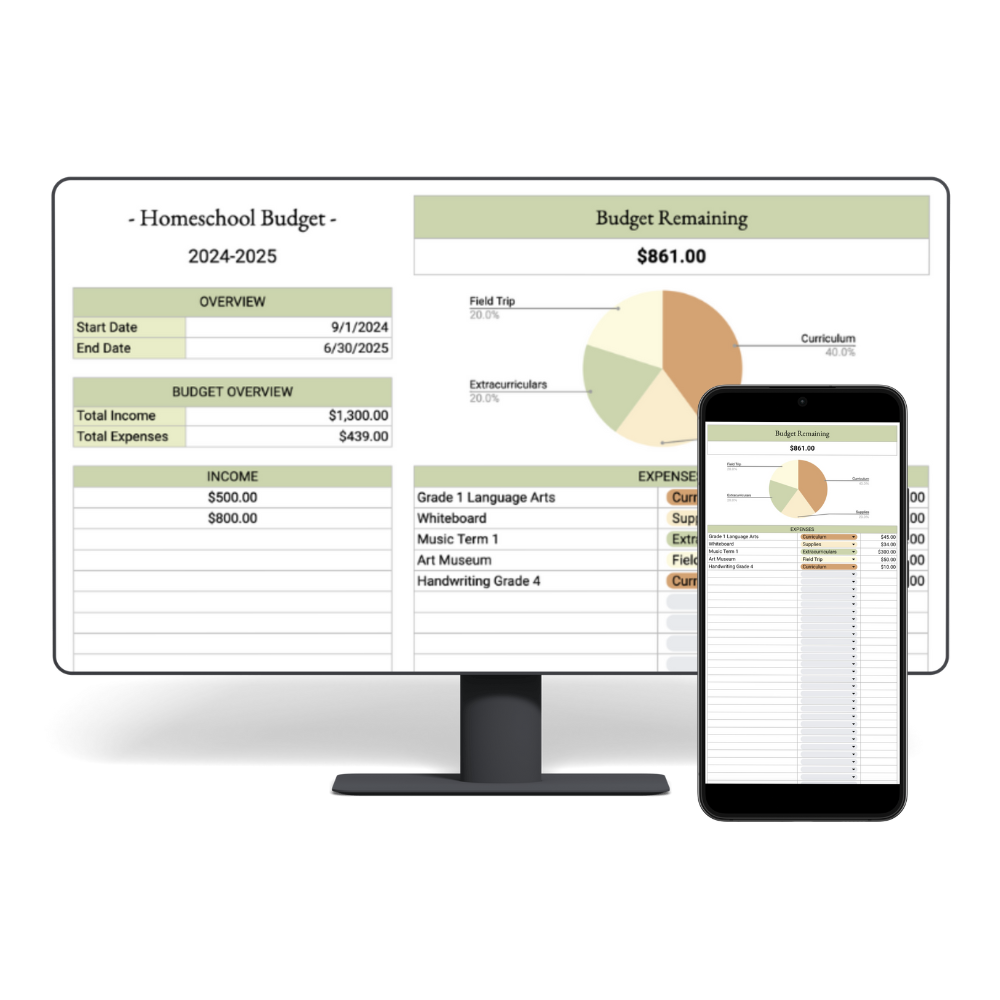
There are loads of options out there, but I’ve also made a free Homeschool Budget that you’re more than welcome to use. It’s set up in Google Sheets which is also free.
Grab your copy below.
As far as paid tools go, we use the YNAB app for this and have done so for years.
I don’t have it for just homeschooling, but for my business as well as our household budget.
So many people buck the idea of having a budget because it feels restrictive. In reality, it’ll give you a lot of freedom and take the weight off your shoulders.
You won’t have to guess as to how much you can spend on homeschool supplies, and it really simplifies the decision making process.
If there’s money in the budget for it then go ahead and buy it…if there isn’t, then you have your answer.
You don’t need an app like YNAB to keep a budget (although it does make life super easy) and using a spreadsheet on Google will also work totally fine.
#2 Keep It Simple

Homeschooling has really grown in popularity over the course of my life.
Back when my mom was homeschooling myself and my 3 younger siblings, resources were limited. Homeschooling was still a fairly novel thing.
Plus, there wasn’t social media and therefore even if there were great supplies and resources available, you didn’t hear about them so easily.
While this may sound like a negative thing, it actually helped to keep things simple.
You don’t NEED all the pretty posters, the cute mug with a “homeschool mom” quote on it, or the perfect caddy for all your different art supplies.
I know they’re pretty and there’s nothing wrong with having them, but you don’t actually NEED them in order to homeschool effectively.
In all honesty, a pencil, some paper, and a library card is about all you actually need to get the job done.
If you cannot afford all of the extras, don’t sweat it.
Keep it simple, and when you can add to the budget, enjoy it!
#3 Use Free Resources

I’m actually amazed at how many free resources are available to homeschool parents these days.
We’re talking entire curriculums such as Easy Peasy All-in-One Homeschool or Ambleside Online.
Do some research and you’ll likely find a ton of resources that you can use to homeschool your child that won’t require any monetary cost at all.
Pinterest is another area where you can find lots of free printables and unit studies that have been put together.
Also, Teachers Pay Teachers has many free resources and also many at a very low cost.
You can find one of the free printables that we offer right here.
#4 Make Use of Your Library

FREE BOOKS.
I mean, seriously.
Make use of your local library.
I know that you won’t always find what you need, but you can often find a substitute or something very similar.
Another great option is Libby. They have a load of free audiobooks that you can use in your homeschool.
#5 Print at Home

I’ve written extensively about how to print curriculum and homeschool resources from home in this post.
Not only does it save on shipping costs (especially if you’re international) but it also means that you can reuse curriculum over and over again for your children.
For instance, The Good & The Beautiful offer their Language Arts levels 1-5 free on their site as a PDF download.
Because I have a great printer, I can print it at home for less than $5 per book.
I use the Epson Ecotank 4750, but anything from the Epson Ecotank series is amazing. Canon also has a range that uses that same ink-efficient technology, although I haven’t had any experience with their printers myself.
#6 Buy Off Brand
There is no award for only buying on brand. Seriously.
I know there are some things that you buy for quality, and I totally get that.
However, remember to look outside of the box and see if there are cheaper versions of the same product available.
#7 Look for Used Curriculum
Many curriculum components aren’t consumable and can therefore be resold at a lower price point.
Join buy, sell, swap pages on Facebook and be on the lookout for curriculum that you can purchase second-hand.
This is most often useful for teacher guides and other non-consumable products.
It can save you a ton of money.
I have purchased many books second-hand from Thriftbooks and eBay which has literally saved us hundreds of dollars.
Conclusion
Homeschooling does not have to cost the earth.
This whole mindset of a quality education costing a heck of a lot of money is more damaging than helpful.
Of course, we’d all love to have an unlimited budget to spend on school supplies, field trips, and other beautiful educational things, but your homeschool is no less valuable if you don’t, or simply can’t.
The value of homeschooling comes from the relationships developed with your kids, the time spent together, and the attitude you have towards learning.
Those are not things that money can buy.