
The Best Daily Schedule for a 3 Year Old (with or without a nap)
*This post may contain affiliate links. As an Amazon Associate I earn from qualifying purchases.*
If you’re wanting to set up a daily schedule for a 3 year old or just tweak the one you’ve currently got then you’ve come to the right place.
This post will give you a great idea of what your 3 year old’s daily routine should look like in order to meet all of their needs.
Plus, I’m going to include a schedule for the napping 3 year old and also one for the 3 year old that is dropping their nap.
Oh, and let’s not forget addressing the 3 year old that needs a nap some days and other days does not.
Age 3 really is full of lots of transitions and interesting behavior which can make you unsure of yourself when it comes to setting up a daily schedule for a 3 year old.
Hopefully the information in this post will help you feel better equipped to deal with the changes that come along the way.
Keep reading to find out all about it.

Benefits of a Daily Schedule for a 3 Year Old?
If you’re new to the concept of having your child on a daily routine then you might be wondering why on earth parents strive for this.
Here are some (but not all!) of the benefits of having a daily schedule:
Security – Your 3 year old’s world is changing by the minute as far as their mental and physical development goes. Having a daily routine provides them with something that doesn’t change drastically.
Sure, there’s some flexibility but overall they’ll know what to expect and feel secure.
A Regulated Metabolism – I used to work as a nurse at a General Practitioner’s office and you know what I found? The patients that had irregular work schedules were the ones that struggled the most with maintaining healthy eating and weight range.
Having a consistent daily routine greatly helps with regulating your metabolism and the same stands true for your child.
Adequate Sleep – Parents so often underestimate just how much sleep children need. We live in a society where being constantly busy is admired even when it isn’t healthy.
Slowing down and prioritising your child’s sleep is a much better alternative. Having a daily schedule will help a lot with that.
Better Emotional Regulation – How do you behave when you’re lacking in sleep? Not as well as when you’re well-rested, huh?
The same is true for children which is why having a consistent routine is of great benefit to them.
The consistency and security that a schedule gives will lead to fewer meltdowns than the alternative.
Things that Can Help the Schedule
Before I share with you the sample schedules, I thought it would be helpful to chat about a few things that can make all the difference to how well the schedules go.
A schedule in and of itself is not a magical solution to behavior, sleep, or feeding issues.
There’s so much to it than that and it is where your parental discretion comes into play.
Routine Cards

I use these routine cards with both of my older children and they have worked so well for our family.
You can print them out and laminate them if you’d like and then put them wherever works for you.
I just have them on our refrigerator but I’ve seen moms put them on the wall or put velcro dots on the back and stick them on a chart.
This pack comes with loads of different cards but you can also create your own if it’s not already pre-made.
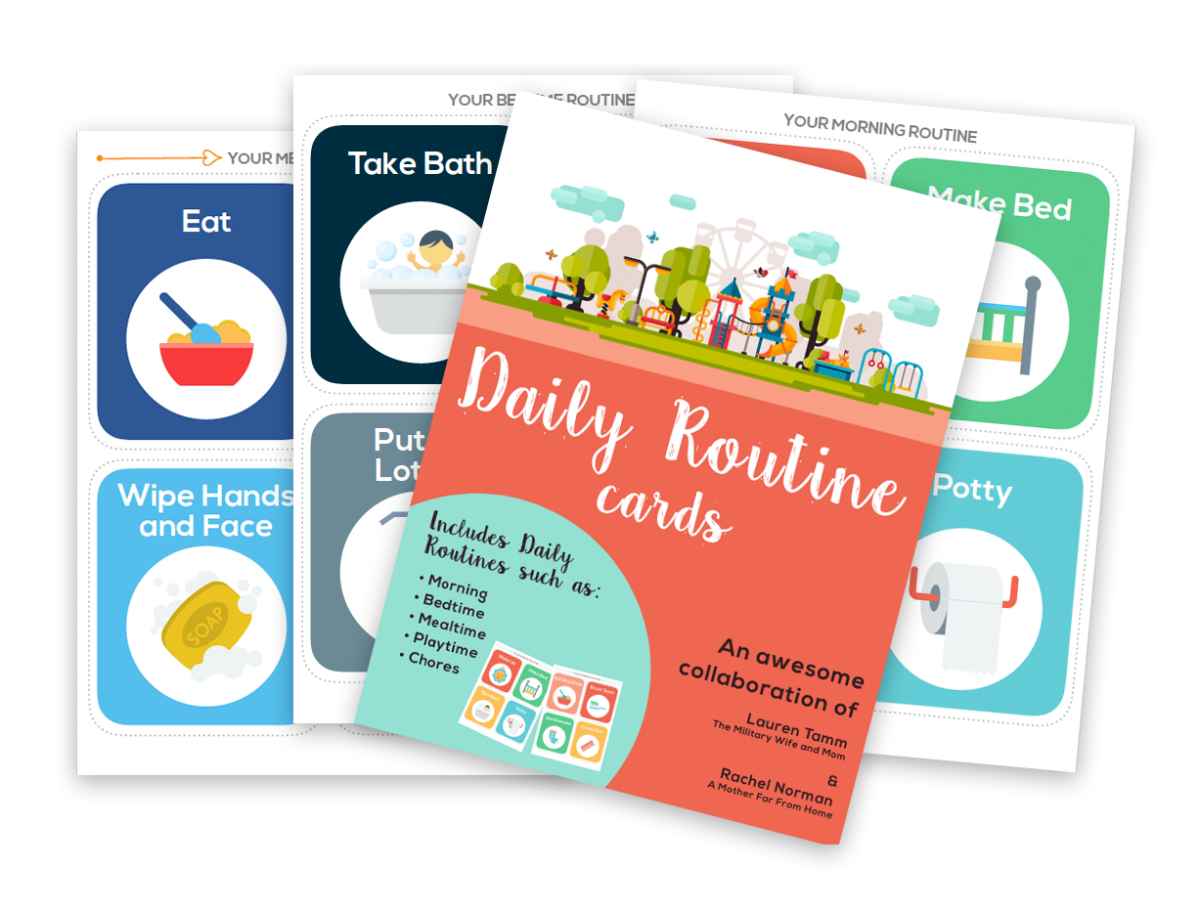
Check out the Routine Cards here.
It makes it so much easier to avoid power struggles when your toddler knows what to expect. Your child will learn when it is time to brush teeth, wash hands, have a rest, or get dressed.
These are important things in your little one’s daily toddler schedule and making them habits starts by creating a gentle routine.
Toddler Clock
We’ve been using a toddler clock since my eldest was 18-months old and I cannot recommend them enough.
Toddlers and preschoolers struggle to know what time it is but having a toddler clock will give them clear boundaries.
However, as with the schedule, a toddler clock is not magic. You will still need to set clear expectations and follow through with consequences.


My kids are now 6, 4, and 2 and all 3 of them have come to learn that they are allowed to get up when Mr Sun is awake.
It is such a simple and clear way of setting a boundary that they really can’t argue with. If they get out of bed before then we simply have them look at the clock and show them why they aren’t allowed up yet.
Consistency
For a schedule to really be beneficial and successful there needs to be consistency on your part.
I don’t mean being a drill sergeant. You absolutely need to be flexible, however, being consistent with the time you start your day, etc will make all the difference.
Even as adults we thrive better with some level of consistency. We usually wake up around the same time and go to sleep around the same time.
Not all of our schedules look the same but our own schedule does tend to have some consistency to it. Our bodies naturally fall into this.
Related: How to Find Balance With Toddler Discipline
Follow Through
Your 3 year old is perfectly old enough to understand that certain actions have consequences.
Follow through with the expectations that you set and you’ll find that they adjust well to their routine. Having boundaries and certain expectations will ultimately give them a sense of security.
Daily Schedule for a 3 Year Old With Nap

Okay, time to talk sample schedules.
These are the schedules that we’ve used with my daughter. She started her life with very high sleep needs but they dropped fairly drastically once she turned three.
I’m not referring to any kind of 2-year sleep regression (which I address in this post), but she genuinely needed less sleep. Sleep regressions are their own thing entirely.
If this happens to you, I suggest sticking with your current schedule for a couple of weeks and if things don’t improve, then reevaluate and go from there.
Your child’s sleep needs will be unique so remember to cater for that when creating your own schedule. These sample routines are just meant to give you an idea of what you can do.
Always take the needs of your child into consideration when planning out a typical day.
Sample Daily Schedule For A 3 Year Old With A Nap Time
- 7:00 AM Wake time for the day
- 8:00 AM Breakfast
- 9:00-10:00 AM Independent Playtime
- 10:30 AM Snack
- 10:30-11:30 AM Outdoor play or indoor activity
- 11:30 AM TV time
- 12:00 PM Lunch
- 12:30 PM Listen to mom read
- 1:00-3:00 PM Nap
- 3:00 PM Snack
- 3:00-3:30 PM TV time
- 3:30-5:00 PM Free play
- 5:00 PM Family time
- 5:30 PM Dinner
- 6/6:30 Bath
- 7:00 PM Bed
With this schedule, your 3 year old may need a later bedtime to accommodate the nap.
This was one of the reasons we ended up dropping the nap because she was taking till 9 PM to fall asleep for the night.
You may just need to give your toddler a shorter nap instead of cutting it, so try that first.
Daily Schedule for a 3 Year Old With No Nap

So now let’s see what a schedule looks like without the nap:
Sample Daily Schedule for a 3 Year Old With No Nap
- 7:00 AM Wake for the day
- 8:00 AM Breakfast
- 9:00-10:00 AM Independent Playtime
- 10:30 AM Snack
- 10:30-11:30 AM Outdoor play or indoor activity
- 11:30 AM TV time
- 12:00 PM Lunch
- 12:30 PM Listen to mom read
- 1:00-2:30/3:00 PM Quiet time
- 3:00 PM Snack
- 3:00-3:30 PM TV time
- 3:30-5:00 PM Free play
- 5:00 PM Family time
- 5:30 PM Dinner
- 6/6:30 Bath
- 6:30/7:00 PM Bed
You may find that if your child has recently started dropping their nap then they really need to be in bed a bit earlier. A lack of sleep does not make for a happy toddler or good morning. They often end up having poor nighttime sleep as a result.
3 year olds typically need around 10-13 hours of sleep in a 24-hour period. Sometimes it just need to be shuffled around a bit.
We almost always have our 3 year old in bed at 7 PM by the latest and she sleeps super well. My children have all been early risers but they’re rarely awake before 6:30 AM.
You may also be wondering what rest time consists of. It will look different for everyone but for the first hour, I like my children to either read books or play with quiet toys while listening to an audiobook.
The second hour is when I’ll often allow educational games on the iPad (such as Reading Eggs).
Related: How to Transition from Naptime to Rest Time
Dropping the Nap

As I mentioned, our daughter no longer naps but it took a little while to get there.
Her older brother did the same thing where he went back and forth for a while.
What I wish I had known with my first is that it’s okay for them to still need a nap a few days per week. It doesn’t have to be all or nothing.
When your child is still in the transition stage I believe it is important to give them the opportunity to take a nap if they really need it.
That is why rest time is still a thing in our home (well, that’s one of the reasons anyway).
For the first hour we keep things very low key so that if my 3 year old is tired she can have the opportunity to fall asleep.
If she isn’t tired, then it still gives her mind a chance to rest.
So What Is the Best Daily Schedule for a 3 Year Old?
The answer to this is simple. The best daily schedule for your child is the one that works.
It doesn’t have to look like anyone else’s as long as your child is happy and thriving.
Use chore cards if you want, or don’t worry about anything formal. There aren’t really any rules except for making sure your child get’s enough sleep.
Daily activities can include an afternoon nap, sensory play, daily outings, or just staying at home. You know your child best.
Making sure it is sustainable is a good idea and will go a long way towards success, otherwise, you’ll end up burnt out and at odds with your toddler.
Coping with Bedtime

In my experience, it is around age 3 that children start to test the boundaries of bedtime.
All of a sudden there are endless questions, absolutely “necessary” toilet trips (x10), and many other stalling tactics.
I know that many parents would call this a sleep regression but in my opinion, it is more about establishing clear boundaries.
Make sure that you have addressed your child’s sleep need so that you know you’re not expecting the impossible from them, but otherwise it is wise to do the following…
Set clear expectations
Let your child know what you expect from them.
Once you’ve said goodnight is it okay for them to get up again? If so, how many times?
What reasons are they allowed to get up for?
Your expectations are going to be different from the family down the road so don’t worry about what others are doing.
Just focus on what you’d like in your home and communicate those to your child.
They are smart and they will understand.
Bring it forward if naps are missed
If naps are skipped and your child is not consistently finished with naps then bring bedtime forward.
If you don’t, your child will end up an overtired mess.
They may be fine for day 1 and 2, but come day 3 and they’ll struggle.
Be consistent

Kids are so smart and you do them a disservice by expecting them to do a certain thing and then change the rules on them.
Keep things consistent so that your child has security in the boundaries that you’ve set for them.
Follow through
Above all…follow through. If you set consequences for bedtime shenanigans then enforce them.
It feels mean but what is more unkind as a parent is allowing your child to forever get their own way.
Life doesn’t work like that and it’s much easier to teach these lessons in a safe and loving environment than it will be in a great big world one day.
I really do hope that all of this was helpful to you! I’m forever grateful for the freedom that routines and schedules have allowed for our family.
Not to mention agreeable children that sleep well and know to listen to what their bodies need.